Showing posts with label The Charioteer. Show all posts

Thursday, December 11, 2014

Straights

All my life I have been despised by straight men.  Not because I was a thief, or a liar, or a rapist.  Not because I was cruel or vicious or evil.  But because I didn't conform to their image of what a boy, or teen, or man should be.  For something I couldn't help, because I was born that way.  They were happy enough for me to pretend to be what I wasn't, to lie to myself and them.  They were happy enough for me to do without love, and without the affection and caring that they got from their partners, because their partners were women, and I (for a long time) wasn't even allowed to make love to a man because it was illegal, punished by a prison sentence.  Their contempt has scarred me and deformed me.

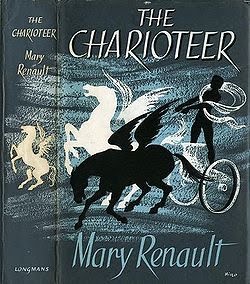
"There had never been a time when he hadn't thought of himself as one of this company the mischance of battle had brought together: one with a secret, as many others had of one sort or another; one with an oddity, but there were plenty of those.  Lovell, who had owned a freak-booth that toured the fairs; Jansen, who was three parts coloured; Willis; Charlot; Odell, who had started with the handicap of 'talking posh'.  Now in a cold solitude he imagined, everywhere in the shadows, men quietly watching, curious, or mocking, or repelled, according to their kind, but all thanking their Maker for the solidarity that didn't include him."  [The Charioteer, by Mary Renault]

But if I say I despise and dislike and mistrust straight men, the response I get is that that is "so unfair", that "not all straight men are like that", and so on.  Indeed.  Yet the anger and hurt and disdain inside me aren't salved by exhortations to be "forgiving"  and "understanding"  and "accepting".  Bitter experience has taught me again and again not to trust men, not to let them into my heart, even as friends, not to rely on them to accept me for what I am.  No one can say I am stupid, and one definition of stupidity is to go on doing the same thing again and again even though what you do doesn't work and merely gives you pain.

And behind this whole cultural hate-fest lies the Church, with its assiduous drip-feed of homo-hatred and lies: "abomination", "intrinsically disordered", "kill the gays".

I cannot forgive or forget.


Monday, March 14, 2011

Majorca Flats -- 87

Keith stared down at the linen table-cloth and the shining “hotel silver” cutlery. Then he looked at the array of liquor bottles stored on the shelves behind the counter.
Jason waited patiently,
At last, Keith muttered, “Have you ever wished you weren't gay?”
Jason thought about it. “Well, at the beginning I had a relationship with a bloke at school. It didn't seem such a big deal, in a way. I read this book called The Charioteer which starts with a scene in a boys' boarding school. It's written by, um, …..”
“.... Mary Renault. Yeah, I know it. What gay guy doesn't?”
“ … anyway, in it she says something like 'some people are like cattle, which will lick up salt wherever they can find it if they are deprived of it. What she was saying is that with us 15, 16, 17 year olds, we wanted sex, and since we couldn’t have girls, being in a boys' boarding school and all, we were attracted to each other. And it was half expected but by the same token totally expected that after school we would get over it and get married, and most of the men did, eventually.”
“But you didn't?”
“No. But it never seemed 'gay' to me, if you know what I mean. My guy,” and here Jason had to stop and swallow the lump in his throat, “my guy,” he went on, his voice strained, “ he was so straight-acting. He was just a regular bloke who loved me. We didn't go to gay pubs, we didn't sleep around, he had lots of straight friends who knew about us. It was so … ordinary. So I've never felt 'gay'. I mean, I am, but ….” And he thought of Luigi, and decided that he had to see him again, just to tell him the truth about himself.


Friday, June 25, 2010

The Two Marys


I tend to read books and watch films which make me feel that there is stuff, that there are places in the world, which are good. Yup, I know. We have pollies and captains of industry and born-again self-righteous pricks. And the Taliban (recently in the news for hanging an eight year old). Charming. And prissy bureaucrats who say 'them's the rules, fucker.' Selfishness and cruelty and ignorance and greed.

So as an antidote I read and watch escapist entertainment. Real enough to allow me to suspend disbelief but unreal enough to involve 'happy endings'.

Mary Renault and Mary Stewart are two authors who thrill me as well as make me feel some things might be all right with the world. No gay man of my generation won't know about Mary Renault. The Charioteer was one of the first mainstream novels to treat gays sympathetically. In fact, together with Victim it is credited with helping bring about the repeal of the anti-gay laws in Britain. I didn't know any other gay blokes. I had no idea how to be a gay. There were no gay bookshops where I lived. All I knew was that I was deeply in love with a man. The Charioteer helped me survive, helped me chart a course through the wild country of gay, helped me set up the guidelines and parameters which still direct me today: that gay is not immoral, that bi is 'gay plus, not minus', that the sex isn't all, that there can be a kind of 'exalted paganism' which is an alternative to the narrow, vicious and hurtful dictates of Christian fundamentalism.

The Last of the Wine, her next book, was the first set in ancient Greece, and again, it showed a world where same-sex love was ordinary, not a repulsive sin and a 'crime against nature' (which on the other hand of course much of modern industry and life is, though the aforesaid captains of industry wouldn't agree with you.) Her stories celebrate us. And are also enthralling, magical, convincing.

The other Mary, Mary Stewart, wrote romantic thrillers as well as a series about Merlin and Arthurian Britain. Her romantic novels are het, and I'm never quite sure whether to identify with her heroines or heroes. Her heroines are spunky, courageous, and altogether attractive, unlike so many heroines from this kind of novel. The villains are always blonds with blue eyes (how we laughed) and the heroes always dark-haired and dark-eyed. But the romance is special, and, even on the tenth rereading, the stories still gripping.

Both Marys are old-fashioned now. They wrote for the educated middle classes, people who could speak some French, who knew at least some Greek and Latin, people who didn't have to struggle against penury. The inimitable Jane says, apropos of poverty,

I shall not be a poor old maid; and it is poverty only which makes celibacy contemptible to a generous public! A single woman, with a very narrow income, must be a ridiculous, disagreeable old maid! the proper sport of boys and girls, but a single woman, of good fortune, is always respectable, and may be as sensible and pleasant as any body else. And the distinction is not quite so much against the candour and common sense of the world as appears at first; for a very narrow income has a tendency to contract the mind, and sour the temper. Those who can barely live, and who live perforce in a very small, and generally very inferior, society, may well be illiberal and cross.

That's from Emma, and that minx is talking to Harriet whom she hopes to raise up in the world.

The middle classes the two Marys wrote for could afford holidays on the Continent, at a time when working class families were lucky to have two weeks at Eastbourne. Both Marys loved Greece, and obviously visited often, setting many novels there and in the Levant generally. Greece after all, when it was pagan and also under the Christian Byzantine Empire, covered the whole of the eastern end of the Mediterranean. (Maybe next post, I'll talk about Cavafy, a modern Greek poet from Alexandria who managed to fill his poetry with the losses of the glories of Ancient Greece and combine it with his own melancholy attempt to find love as a gay man)

I grew up poor. That kind of middle class expansiveness was unknown to me. So these stories were also escapist in another way. I could pretend I was a well-off, confident member of the middle class, that I knew what was what, that I belonged on the broad airy uplands of prosperity, that I too had visited Vienna or Thebes or pre-civil-war Beirut.

Even though both authors have dated, they're still very good at their craft. And both of them celebrate love: Mary Renault gay and Mary Stewart het, but honestly, there's not that much difference. We all need love. And escapist romance never hurt anybody.

Sunday, February 22, 2009

Book and Film Lists

One of Amazon's very clever innovations is to use the (free) input of its customers to create added value for customers and itself. Stuff like customer reviews and customer lists. I've created two lists, though I will be setting up more; one for romantic gay or bi stories; and one for good gay films.

Looking through the list of books I'm struck by how many are 'slash': Swordspoint, The Fire's Stone, The Protector, Luck in The Shadows, Wraeththu, Fire From Heaven, just to name a few. Now traditionally (and some would say, strictly speaking it still is so) slash is about taking heterosexual characters from say Star Trek or Starsky and Hutch and have the two blokes get so close they discard societal taboos and become lovers. At first, slash was written by women for women. But gay-shaded blokes like me find the emotional sensibility of women when they write about men very appealing. I never liked the cum-and-go culture of gay life prevalent when I was a young man. My attraction to men was always much deeper than sex, sometimes, indeed, instead of sex. I'm not saying men don't turn me on. I like cuties of both genders. What I am saying is that my relationships with men were always, from my side, about love and friendship and companionship, and I could (and often did) do without the sex.

So I was drawn to m2m stories written by women, starting with Fire From Heaven by Mary Renault, and then of course (which gay-shaded man hasn't read it?) The Charioteer. To my way of thinking, slash has broadened from Spock/Kirk (which is where the term 'slash' comes from, where it was and still is used to indicate the pairing) to any m2m story whether written by a man or a woman where the 'feel' is like the first slash stories, or like the stories written by Mary Renault, Marguerite Yourcenar (her Memoirs of Hadrian, about the Emperor Hadrian and his Greek slave Antinous, is a masterpiece) and their ilk, which are not 'slash' but are written by women. And I consider that I write 'original slash', reflecting my propensity towards romance rather than sex.

There are sex scenes in my writing. I've put them in partly because I object strongly to the fact that heterosexual sex scenes are treated as acceptable, but homosexual sex scenes are preceded by a warning ("may offend"). In ElvenSword there is a het sex encounter between Fluin and Ilya, and it seemed only reasonable to put in m2m sex between Fluin and Steppan or Fluin and Lthon. But the drivers of the relationships between my characters are love and affection and respect, and only secondarily sex. As it happens, writing good sex scenes is hard. They take me much longer than even dialogue which is hard to get to appear natural without being natural. Real dialogue is elliptical, confusing and boring when written down -- think of the transcriptions of Nixon's phone calls.

As it happens, right now I'm working on Will and Emma's sexual reconciliation in Footy. The hard thing isn't the sex. The hard thing is making her forgiveness and his love convince within the context of the bedroom scene while Sean, Will's lover and Emma's friend, is alone in the bed in the spare room. So I suppose I'd better go and finish it!